

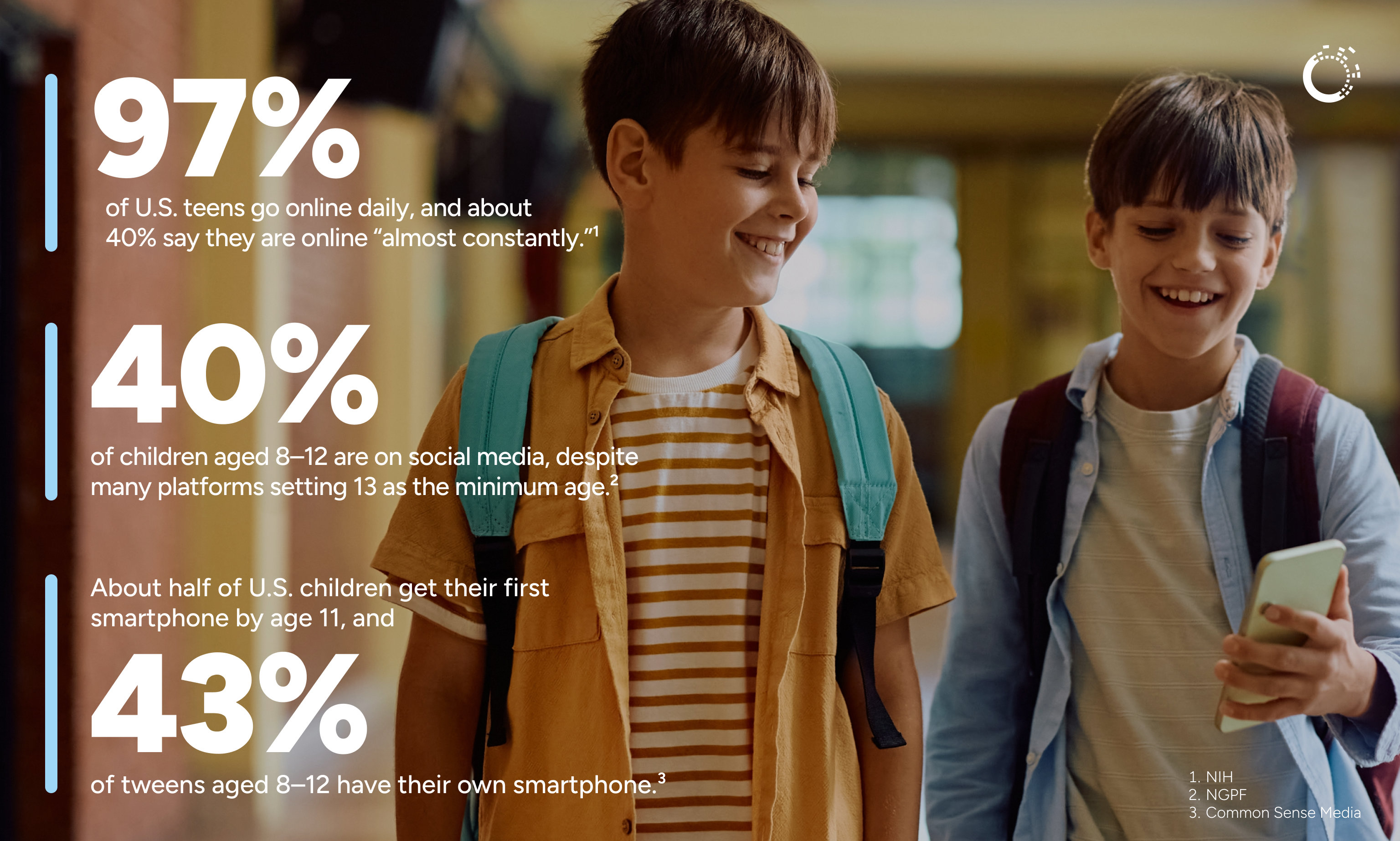
As the back-to-school season is in full swing, millions of families will be having familiar conversations about smartphones, social media, screen time and staying safe online. For many children, a phone is becoming an essential part of everyday life, making child online safety an increasingly important consideration for parents handing over that first device, often with a mixture of excitement and anxiety.
Those conversations are no longer happening just around the kitchen table. They’re taking place in governments all around the world, too. Australia became the first country to introduce nationwide restrictions preventing children under 16 from holding accounts on many major social media platforms, while the UK has announced similar proposals alongside additional protections around features like livestreaming and messaging from strangers.
Public attitudes are shifting too. Three-quarters of U.S. adults support banning cellphones during class for middle and high school students, and more Americans now support restricting phone use throughout the school day than oppose it.
The reason for this is simple: parents are finding it increasingly difficult to keep pace with the challenges children face in an always-on, connected world. While smartphones have opened up incredible opportunities for learning, communication and independence, they’ve also introduced new concerns. Parents worry about harmful content, cyberbullying, scams, phishing attempts and unwanted contact from strangers, but also about the impact of constant connectivity on concentration, sleep, mental wellbeing and healthy digital habits. For many families, striking the right balance between keeping children connected and keeping them protected has never been more difficult.
The Reality of Raising Connected Children
As a parent, it’s a challenge I think about a lot. Here in the UK, initiatives like Smartphone Free Childhood encourage parents to delay giving their children smartphones for as long as possible—a goal many families, including mine, support. But the reality is that connected technology is already woven into everyday life. Much of my older son’s schoolwork is now assigned, accessed and completed online, making a connected device an essential part of his education. The question is no longer whether children should use connected technology, but how we make that technology safer when they do.
The challenge isn’t simply deciding when to introduce technology. It’s navigating an online safety landscape that’s become increasingly fragmented. Parents are expected to configure apps, manage parental controls across multiple devices, adjust operating system settings and continually adapt as new platforms, services and threats emerge. Even as governments introduce new regulations, much of the responsibility for keeping children safe still falls on families themselves.
That’s why it’s time to start thinking differently. Rather than relying solely on apps and device settings, what if the telecom network itself could help shoulder some of that responsibility?
For decades, connectivity has simply transported voice, messages and data. As telecom becomes cloud-native and programmable, however, the network is evolving into an intelligent platform that creates new opportunities to build safety directly into the connectivity experience.
Building Child-Friendly Connectivity
As networks become programmable, connectivity can evolve from a passive utility into an intelligent service. Rather than simply moving communications from one place to another, the network can help shape and protect the experience itself—allowing brands to create mobile services tailored to the unique needs of different customers.
For families, that opens up an entirely new way of thinking about child online safety.
Imagine a mobile plan designed specifically for children. One where parents can choose to block categories of websites, restrict access to age-inappropriate content, allow only approved applications or zero-rate educational platforms so learning never counts against a family’s data allowance. The same service could also help protect children from unwanted communications by blocking suspected scam or spam calls, filtering suspicious text messages or allowing only trusted contacts approved by parents to reach a child’s device. Policies could evolve as children grow, giving families more flexibility without relying on multiple apps or manually configuring every device.
Because these policies are managed through the connectivity platform rather than individual devices, they can be applied consistently across a child’s connected ecosystem. Whether they’re using a smartphone, tablet, smartwatch or other companion device, the same protections and access policies can follow their connectivity rather than requiring parents to configure each device separately.
This represents a fundamental shift in how we think about mobile safety. Rather than expecting parents to shoulder the entire burden, the network can become another layer of protection that’s built into the service from the very beginning.
Examples of Child-Focused Connectivity Offerings
We’re already starting to see this in practice. Around the world, a new generation of connectivity providers is putting children’s digital wellbeing at the centre of their offering. While their approaches differ, they share a common goal: making mobile experiences safer by design.
Rebel Telecom
UK-based Rebel Telecom has built an MVNO around children’s digital wellbeing, combining a purpose-built smartphone, child-friendly operating system and parent-managed controls to create a safer mobile experience.
CrossMobile
Poland’s CrossMobile combines mobile connectivity with AI-powered cybersecurity, helping protect children from cyberbullying, grooming, harmful content and other online threats while enabling parents to filter websites and apps.
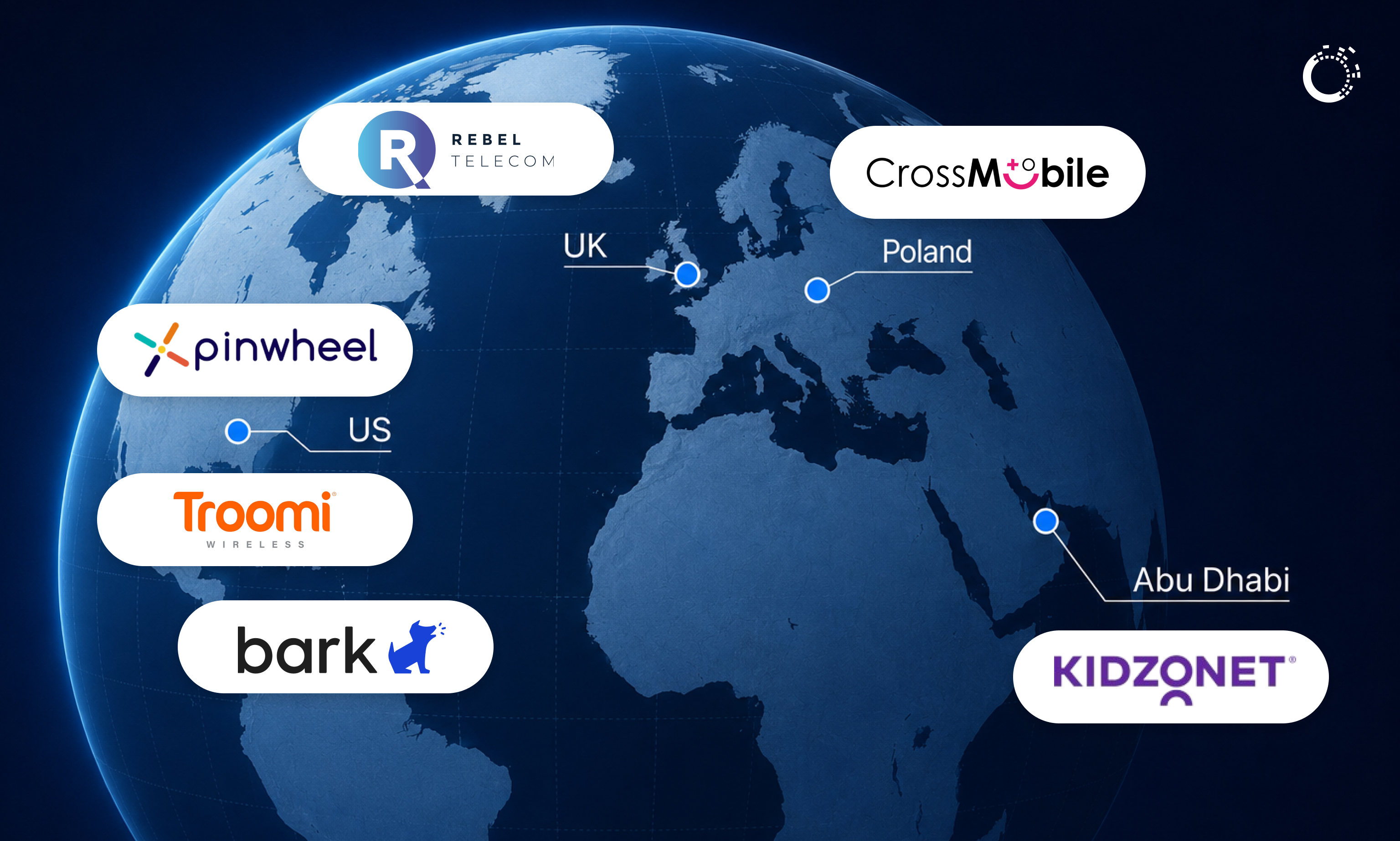
KIDZONET
KIDZONET enables telecom operators to deliver network-level child protection through SIM and eSIM-based content filtering, making online safety a built-in part of the connectivity experience rather than relying on additional apps.
Pinwheel
Pinwheel combines kid-safe smartphones with a purpose-built operating system, giving parents tools to manage contacts, communications, screen time and app access while encouraging healthy digital habits.
Rethinking Child Online Safety at the Network Layer
While these examples demonstrate the growing demand for child-friendly connectivity, many focus on specialized devices or consumer-facing applications. OXIO believes the next evolution lies deeper in the network and the platform that powers it.
Through OXIO’s Telecom-as-a-Service (TaaS) platform, brands can build family-focused mobile experiences using capabilities such as Traffic Labels, enabling them to define how different categories of internet traffic are handled. Educational apps can be zero-rated so they don’t count against data allowances, age-inappropriate content can be blocked, and access policies can be tailored to different users or evolve as children grow. Rather than relying solely on parental control apps or individual device settings, these protections become part of the connectivity experience itself.
The direction Big Tech is moving in reinforces the need for these kinds of controls. As part of its recent child online safety settlement with U.S. states, Meta has agreed to introduce a range of new protections for under-18s on Facebook and Instagram, including default daily time limits, overnight access restrictions, muted notifications during school hours and stronger parental controls.
These are meaningful steps, but they also raise a bigger question: why should families have to wait for every individual technology platform to decide what protections to provide? A social media platform can control what happens within its own environment. Greater control over the telecom core creates the potential to apply protections across a much broader range of connectivity experiences.
Because OXIO owns and controls its telecom core, there is an opportunity to expose additional capabilities that could give brands even greater flexibility to build connectivity services specifically for families. Imagine giving parents the ability to pause a child’s line in real-time, restrict calls and messages to approved contacts, block specific websites or applications, establish “quiet hours”, or route web traffic through content-filtering services to help prevent access to adult or inappropriate material.
The difference is that these protections wouldn’t necessarily need to exist as separate tools layered onto individual devices. Core ownership creates the foundation for network and platform capabilities that can be exposed to brands and ultimately built into the mobile experience itself. It opens the door to connectivity that can be configured around who is using it, when they’re using it and what level of access is appropriate for them.
But keeping children safe isn’t just about what they can access online, or when and where they can access it.
Children are increasingly exposed to threats through calls and text messages, from phishing attempts and scam calls to AI-generated voice fraud and unwanted communications. And the scale of the problem is growing. Vodafone estimates that one million young people in the UK fall victim to online scams every year, with 13-year-olds among the most frequently targeted, and the average financial loss exceeding £100 per scam. And in the US, a Federal Trade Commission study found that more than half of those who reported losing money to scams or fraud were aged 19 or younger, with $55 million in losses.
These are risks that traditional parental controls were never designed to address, and this is where network-native innovation becomes critical.
OXIO’s Advanced Core Routing (ACR) brings intelligence directly into the telecom core, enabling calls and messages to be analyzed and acted upon in real time before they reach the recipient. Rather than simply transporting communications, the network itself can become an active layer of protection that helps identify, redirect or block suspicious activity before it ever reaches a child’s device. In practice, that could include automatically transferring a suspicious incoming call to a parent or guardian for review, rather than allowing it to reach the child directly.
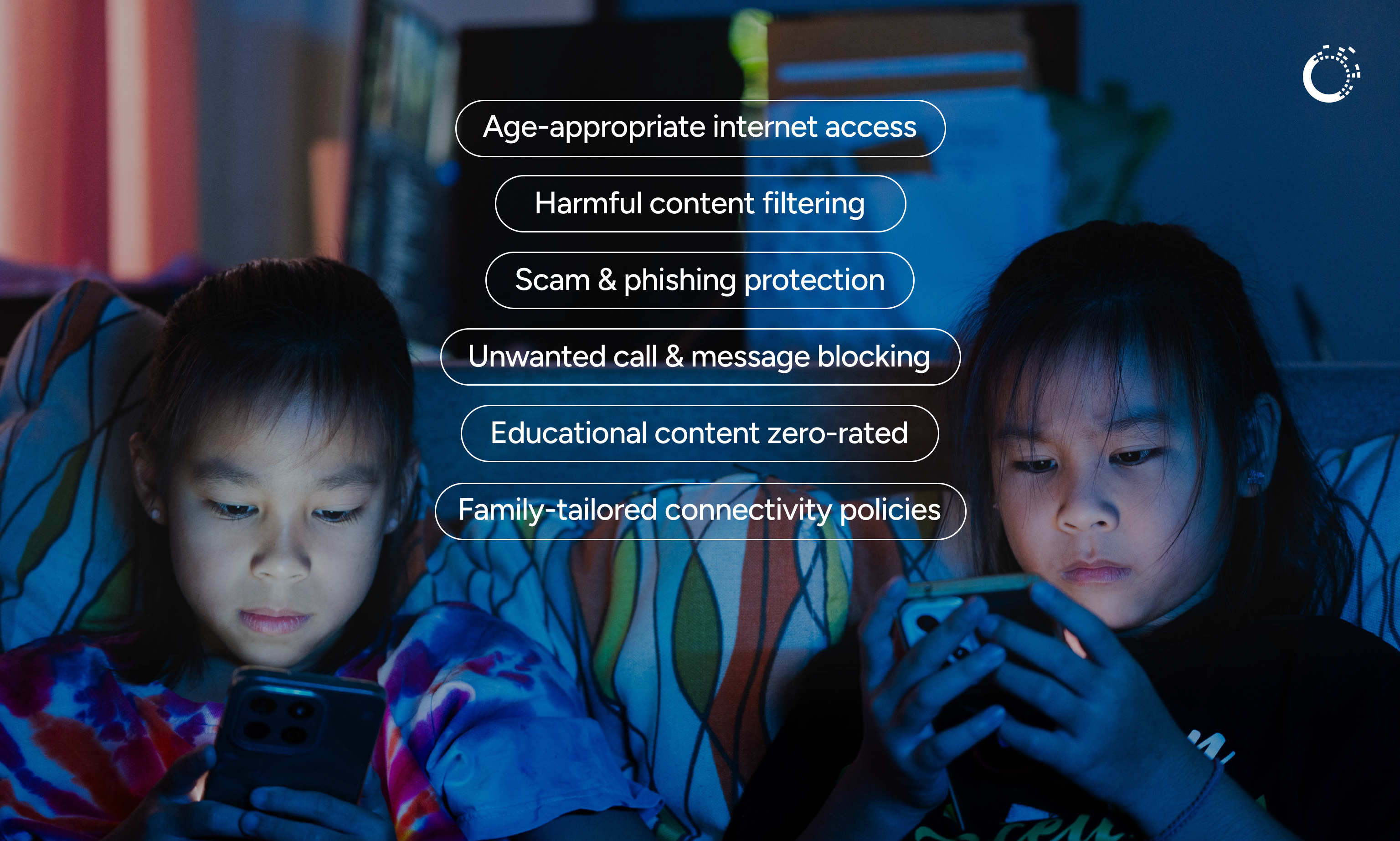
Together, programmable connectivity and network-native intelligence represent a new way of thinking about digital safety. Instead of placing the responsibility solely on parents or expecting every device and application to solve the problem independently, telecom itself can become part of the solution in creating safer, smarter and more family-friendly mobile experiences by design.
The Future of Connectivity for Children
The future of child online safety won’t be solved by a single app, device or regulation. It will require every part of the digital ecosystem to play a role, including the network itself. As connectivity becomes programmable and intelligent, telecom has an opportunity to become an active partner in creating safer digital experiences for the next generation.
For more information on OXIO’s Telecom-as-a-Service solution, get in touch with us today.
