
Digital-first brands know the old data-mining playbook is gone. Cookies are evolving toward opt-in. Third-party data is drying up due to stricter privacy laws and platform tracking limits. Tech savvy users are adopting VPNs, privacy-first browsers and tools like ChatGPT for search. Meanwhile, consumers expect personalization, but trust brand marketing less than ever as they lean towards recommendations to influence buying behaviors.
Even for brands that have perfectly crafted mobile experiences, the data collected from apps only tells a small part of the customer’s digital story. How do they behave outside of your app? What competitive apps do they frequent? What time of day do they engage? And how do they move around the world? What if you had visibility into your customers’ digital lives and not just your slice of it? That’s where insights from telecom data come into play. Now it’s easier than ever for you to access them from the mobile network.
OXIO’s Telecom-as-a-Service (TaaS) platform with BrandIQ mobile intelligence gives companies the ability to extend a branded mobile virtual network (MVNO) to their customers and collect valuable, privacy-centric, first-party telecom data insights without telecom expertise or overhead.
Now is the time for brands to launch an MVNO
 Today brands no longer just sell products; they create ecosystems. Sometimes those ecosystems are enriched by branching into services that improve customer connection in exchange for discounts or convenience. Beauty brand Sephora offers a credit card to customers, trading rewards for rich spending data and increased share of wallet. Tesla offers auto insurance to monetize its own risk data.
These companies are not banks or insurers. Similarly, brands don’t need to be telcos to offer mobile connectivity. Today it’s easier than ever to launch an embedded MVNO into your app and loyalty program. With a partner like OXIO, you can further gain access to real-time behavioral insights. Suddenly your brand goes from being a place someone occasionally shops to a daily utility they rely on. With the average American checking their phone 144 times a day according to a 2025 survey by the Journal of Consumer Research, the impact a mobile phone has on brand recognition can not be understated.
Why most apps don’t capture the full picture of consumer behavior
When passively collecting first-party data, most brands think of their mobile app and digital assets. While apps are essential touchpoints, the reality is that very few reach the level of engagement needed to serve as a complete behavioral data engine. The data collected may be valuable for improving and optimizing the overall digital experience, but it’s rarely enough to drive larger strategic decisions.
Consider this: According to surveys, TikTok users spend anywhere from 58 to 95 minutes per day minutes per day in app. Instagram, WhatsApp, and YouTube boast billions of users and see some of the highest daily active engagement globally. Spotify engages the interests of its listeners across music, podcasts, books and live events with the average consumer spending 32 hours a month in app. These platforms dominate user attention not just through content, but by becoming woven into daily life through communication, discovery, entertainment, commerce and even health.
That level of stickiness is the exception, not the rule.
Most apps, no matter how thoughtful and well-designed, simply can’t compete for that kind of attention. They’re visited briefly, transactionally, and infrequently capturing only a narrow slice of your customer’s digital life. The rest of the picture across competitive apps, networks, locations and time remains invisible.
That’s why owning the mobile layer and collecting telecom data insights matters. With solutions like OXIO’s BrandIQ, brands can tap into real-time behavioral signals at the network level, reaching beyond their app and into the level of data reserved for digital platforms and giants. It’s the key to building a complete, 365 degree view of consumer behavior.
Consumers are always on and always mobile
According to McKinsey, consumers now have over three additional hours of free time each week, and they’re spending that time alone, online and on mobile. The phone is now the primary gateway into a person’s life with their phone number being as precious and personal of an identifier as their social security number.
Globally, over half (63%) of the world’s internet traffic comes from mobile phones, reflecting how deeply mobile devices are embedded into everyday routines. In the U.S., Americans spend 4 hours and 30 minutes on their mobile phone, underscoring its dominance as the screen of choice.
So why does this matter for brands? Because every tap, unlock, app switch, network transition and movement across locations is a signal. Although your mobile app shows you what happens inside its walls, the network and phone capture glimpses of everything else. What competitor apps did they open? How did they move through space? When did they switch networks? How long they engage with financial apps? In short, the mobile layer is the only constant companion in your consumer’s journey, and the only channel where you can capture a holistic portrait of behavior.
And because the mobile device is always with the consumer, the mobile layer becomes the richest domain for behavioral insight. The mobile network captures telecom data insights and signals that app analytics can’t. All of these create a profile that goes beyond demographics and declared preferences.
Collect 24/7 telecom data insights from the mobile network
Imagine data collection from a mobile device as happening in stacked layers that reach from the physical world up to business systems. Traditionally, if you wanted to access telecom data, you needed to be a carrier or get it from a carrier. But even then, there are limitations to what carriers share. Typically, this is simple usage data like usage volume, session start/end time stamps, duration and service type to help MVNOs bill, rate and reconcile.
In reality, there’s far more to be discerned from the mobile layer. Think of the mobile layer as connective tissue between the phone’s SIM and every app, network or digital service the user touches. Because OXIO operates its own core network (more about that here), our customers get to own the data pipe that flows from their MVNO. With OXIO’s BrandIQ, they gain access – with consumer privacy always preserved – to the insights that travel through it.
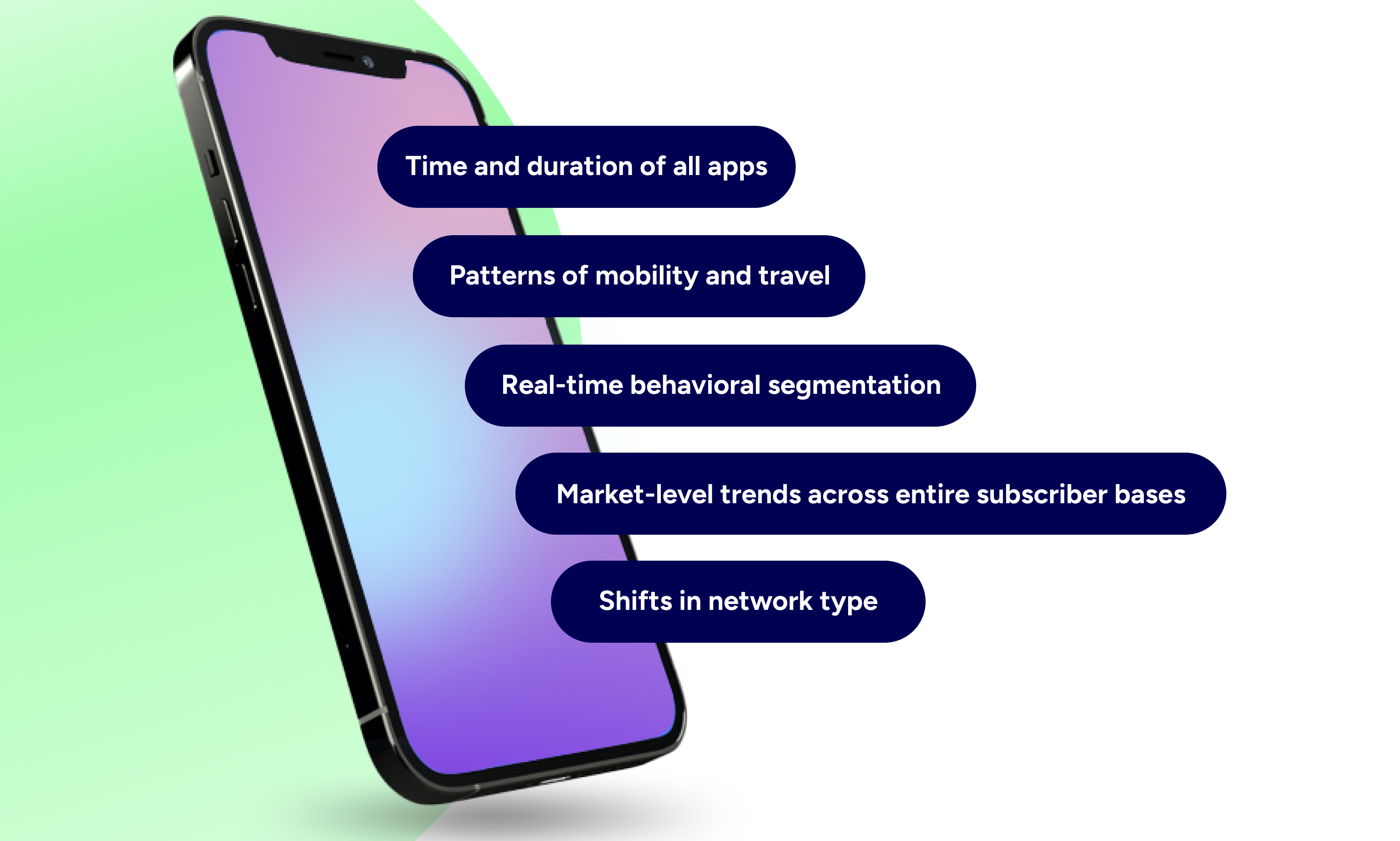
This includes the basic mobile usage data information you’d get from traditional MVNEs as well as actionable business and telecom data insights including:
- Time and duration of app usage across categories and competitors
- Patterns of mobility and travel at home, work and abroad
- Real-time behavioral segmentation
- Market-level trends across entire subscriber bases
- Shifts in network type (Wi-Fi vs LTE vs 5G)
Owning the mobile layer means exclusive, real time visibility and competitive telecom data you can act on.
A 2025 mobile consumer survey from OXIO showed that 75% of consumers would consider opting in to share their mobile data for better benefits. This stat is also bolstered by a Salesforce study showing that 57% of respondents would share data in exchange for personalized offerings or discounts.
How can telecom data improve your business?
Take a dollar store retailer as an example. Companies that sell hard goods want to be interwoven into their customers’ daily lives and compete against easy options like Amazon. That requires finding a connection that goes deeper than convenience. An MVNO tied to their loyalty program keeps customers within their sphere of influence.
Upon launch, OXIO’s BrandIQ enables the dollar store retailer to understand customer preferences outside of their store and store app. With this data, they can build hyper-targeted segments based on more than sales history. Insights include:
- Which competitor apps are being used (Target, Walmart, Amazon)
- How frequently they engage with those apps (30% of time spent on Walmart vs. 10% of time spent on my app)
- Where customers spend time (geographic movement, not just store visits)
Let’s say that BrandIQ identifies that 80% of the retailers’ MVNO customers located in the X neighborhood of Y city open the Amazon app daily. Using this intelligence to track behavioral shifts, the retailer intercepts churn indicators quickly. They trigger a personalized coupon and mobile bonus data. Perhaps they determine that this neighborhood is the ideal location for their next brick-and-mortar store.
Most companies rely on lagging indicators to determine strategy. In a market where personalization wins and timing is everything, BrandIQ gives retailers the edge to act faster, connect deeper, and build loyalty that lasts. And because it pulls from a level of telecom data insights that retailers haven’t had access to before, it feeds into your broader customer view, augmenting the CRM or analytics stack with fresh, actionable intelligence.
The next wave of customer intelligence starts with telecom data
Owning the mobile layer isn’t just a data play, it’s a strategic leap into relevance, loyalty, and lasting engagement. In a world where every swipe, scroll, and stream generates a behavioral signal, BrandIQ gives your brand the rare advantage: always-on visibility into how your customers actually live, move, and make decisions. Most apps will never be full streaming platforms like Youtube, Tiktok or Spotify. It doesn’t mean there’s no way to collect valuable business intelligence without paying a premium to the gatekeepers.
With OXIO, your brand stops watching from the sidelines and starts owning the rails. Embed your business into the everyday rhythms of life to capture insights that fuel product innovation, precision marketing, and deeper customer relationships.
The brands that win will be the ones that move first, act decisively, and build their own data advantage. That starts with owning the mobile layer and the telecom data insights within.

