
The mobile virtual network operator (MVNO) landscape has evolved dramatically over the past two decades. Yet much of the industry still operates within outdated frameworks that limit innovation and control. As a result, models like the “MVNO in a box” have emerged to simplify and accelerate market entry. However, new entrants still often find themselves locked into inflexible solutions, dependent on third parties, and unable to differentiate themselves in an increasingly crowded market.
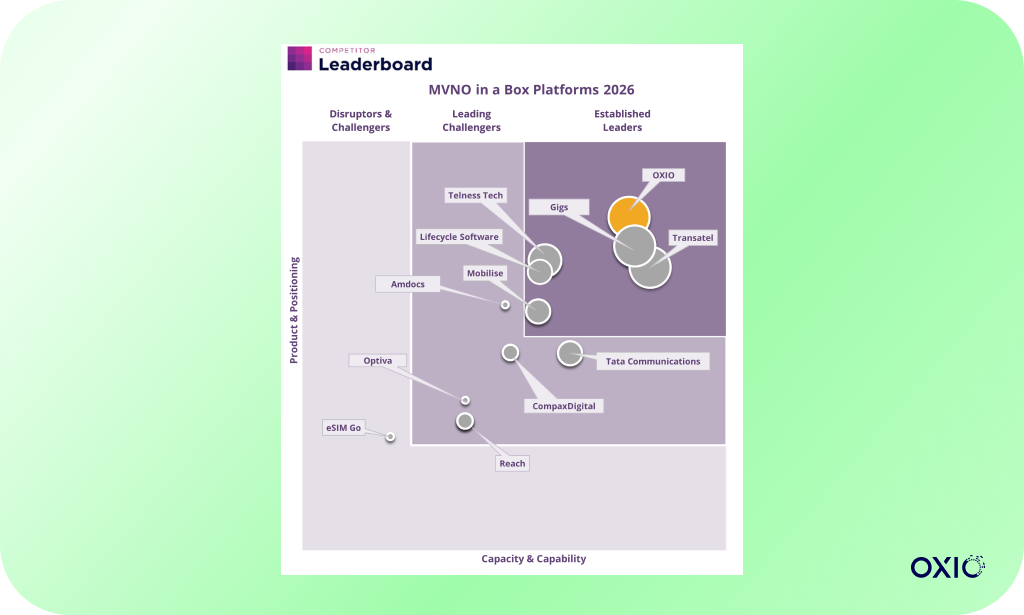
It’s within this context that the term “MVNO in a box” has gained traction, offering a fast path to launch, but often at the expense of long-term scalability and ownership. In fact, OXIO was recently named the #1 and most established leader in Juniper Research’s ‘MVNO in a box’ market report. But what sets OXIO apart (and why it earned this top position) is not just speed to market. It’s the ability to enable entirely new, differentiated use cases across industries, powered by full control over a global, cloud-based telecom core network.
Connectivity shouldn’t be constrained by legacy telecom models. It should be a strategic growth lever that enables brands to scale, personalize deeply, and build stronger, more meaningful relationships with their customers. This is the foundation of OXIO’s Telecom-as-a-Service (TaaS): a modern, cloud-native, API-first platform that goes far beyond traditional “MVNO in a box” solutions, giving brands and MVNOs the control and flexibility to design, launch, and evolve mobile experiences on their own terms.
What is MVNO in a box?
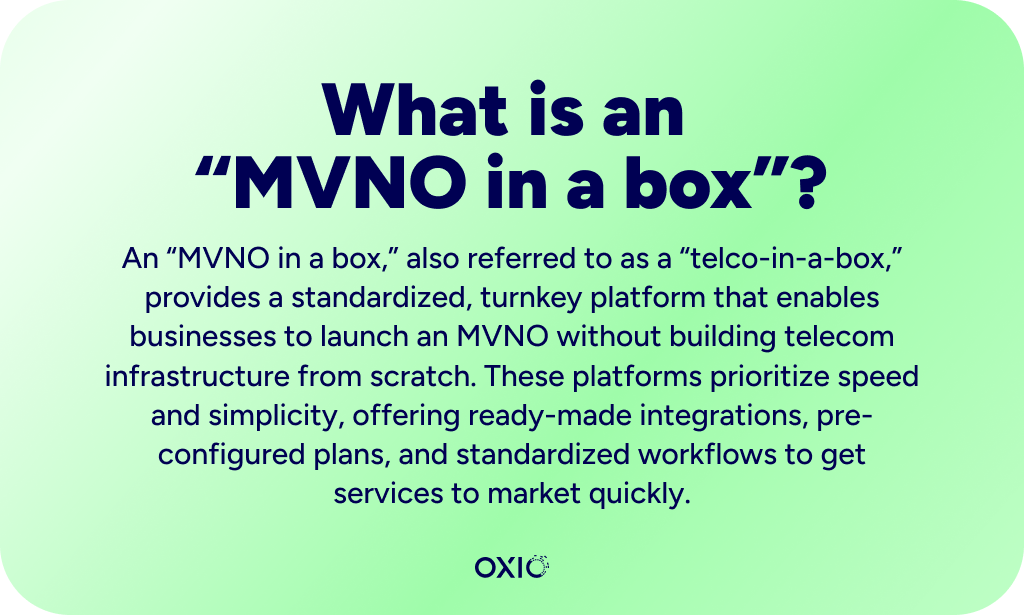
MVNO in a box, also referred to as a “telco-in-a-box,” provides a standardized, turnkey platform that enables businesses to launch an MVNO without building telecom infrastructure from scratch. These platforms prioritize speed and simplicity, offering ready-made integrations, pre-configured plans, and standardized workflows to get services to market quickly.
However, that simplicity often comes with trade-offs. Most MVNO in a box solutions rely on fixed carrier integrations, limited APIs, and rigid plan structures, making it difficult to customize offerings, adapt in real time, or deliver truly differentiated mobile experiences at scale. What works for launch can quickly become a constraint for growth.
MVNEs/MVNAs, some Telecom-as-a-Service providers, mobile enablement platforms, and even carriers themselves typically offer these solutions, and many operate within legacy infrastructure and fragmented partner ecosystems.
The core appeal of an MVNO in a box model is clear: reduced upfront investment, faster time to market, and lower operational complexity. But in practice, it’s often a trade-off between speed and control—a model that is easy to launch, yet increasingly limiting as businesses look to scale, innovate, and own the customer experience.
The limitations of MVNO in a box solutions
When you build your MVNO through an MVNE, MVNA, mobile operating platform, or even directly with a carrier, you typically access a limited set of standardized mobile plans delivered via reseller APIs and packaged as a managed service. These platforms often offer the same plans to every MVNO they support—and that’s where customization ends, unless you invest significant time and resources into bespoke development.
This model boxes you in and prevents you from adapting plans in real time or evolving your offering to match your brand, audience, or business strategy.
MVNEs and similar platforms don’t operate their own core networks. Instead, they lease capacity from mobile network operators (MNOs) and connect MVNOs through standard interfaces. Because they sit one layer removed from the network, their customers remain constrained by the plans and configurations made available by the underlying carrier. The MNO retains control—and the MVNO remains dependent.
Even working directly with a carrier rarely changes this dynamic. While carriers control their own infrastructure, their business models don’t support deep customization. Most offer a limited set of templated plans—typically variations of “unlimited” or capped data—that prioritize operational efficiency over differentiation, leaving MVNOs with little control.
The result is a market where many MVNOs look and feel the same—competing on price and branding rather than product innovation or customer experience. For brands looking to embed connectivity into their core offering, an “MVNO in a box” approach often means giving up control over one of their most powerful growth levers: flexibility.
Limitations of MVNO in a box solutions:
- Fast, but basic: Quick to launch, but limited in functionality and differentiation.
- Limited control: Dependent on carriers for updates, changes, and innovation.
- Lack of flexibility: Minimal ability to adapt plans or experiences in real time.
- Restricted visibility: Limited access to meaningful subscriber insights.
- Constrained support: Standardized, reactive support with little strategic guidance.
Many of these MVNO enablers also fall short when it comes to handling the operational complexities that come with running a telecom business, including critical functions such as tax provisioning that is often deferred to their carrier partners, creating layers of dependency and potential confusion. On top of that, customer support is frequently limited, leaving new MVNOs to navigate technical issues and end-user escalations on their own. For brands entering the telecom space for the first time, this lack of end-to-end support can quickly become a major obstacle.
At first glance, “MVNO in a box” solutions seem simple and quick to launch. However, many MVNOs don’t encounter real challenges until their offering is live. As they begin to evolve their proposition, which often happens once a business learns how customers actually engage, limitations quickly emerge. Every adjustment becomes a custom project, requiring carrier negotiation and adding weeks or months of delay and cost.
Speed and simplicity have their place, particularly for new entrants in the telecom space. Yet, for enterprises and brands aiming to build a flexible, data-driven offering that evolves with customer behavior and market dynamics, a more robust and sophisticated solution is needed.
Why OXIO goes beyond MVNO in a box solutions
OXIO’s Telecom-as-a-Service (TaaS) redefines the traditional “MVNO in a box” model.
OXIO is not an MVNE, MVNA, or conventional carrier. We operate our own global, cloud-native telecom core that powers both our wholesale network and TaaS platform. Through a multi-RAN, multi-MNO architecture, we connect directly to leading carriers, giving us full control over the network layer and enabling unmatched flexibility, scalability, and speed.
What OXIO’s TaaS offers:
- Global, FCC-licensed wholesale network: A fully OXIO-owned and operated, cloud-native infrastructure that powers scalable connectivity across regions and markets.
- Multi-RAN architecture: Seamless global and cross-border coverage, ensuring reliable service and optimized performance for every subscriber.
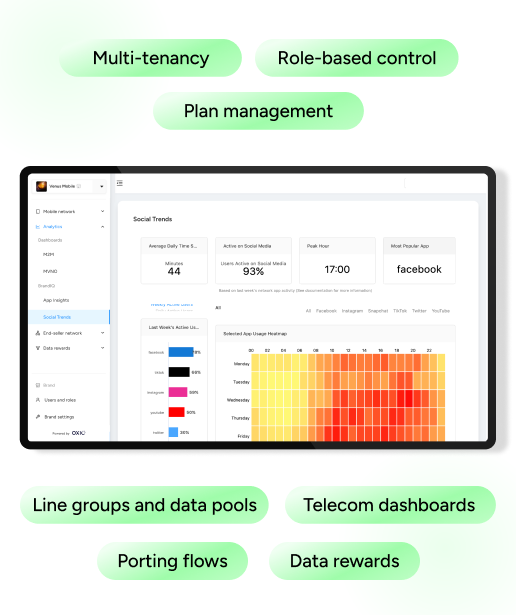
- Complete control and flexibility: Design, price, and manage mobile plans and user experiences in real time through our intuitive TaaS portal, BrandVNO™.
- Actionable, privacy-first intelligence: Gain real-time insights into subscriber behavior and engagement with BrandIQ, OXIO’s business analytics platform.
- Comprehensive customer support: Access end-to-end operational assistance through OXIO’s robust BPO support model, ensuring smooth service delivery and exceptional customer experiences.
OXIO was built to democratize telecom, empowering anyone to build, launch, and scale a custom MVNO that grows and adapts alongside their brand and customers with complete ease and full control. This isn’t about offering pre-baked, cookie-cutter plans. It’s about giving MVNOs and brands that want to embed connectivity into their existing digital products and services the freedom and flexibility to design mobile experiences that truly fit their business and customer needs. With OXIO, those offerings can be updated in real time to keep pace with shifting market conditions, customer expectations, and emerging opportunities.
OXIO’s TaaS solution eliminates the complexity and cost of traditional telecom, allowing customers to scale as they grow and treat telecom as a service they integrate, rather than an asset they build and manage. OXIO cuts out the middleman, so MVNOs no longer need to work with an MNO/MVNA/E to go to market, saving them time, money and giving them the global platform that turns connectivity from a basic utility into a strategic business lever. By defying these traditional boundaries, OXIO is exposing all of telecom’s possibilities, enabling companies to access the data and tools they need to deliver world-class customer experiences that increase revenue and drive customer satisfaction and retention.
How to build your custom MVNO with OXIO’s Telecom-as-a-Service (TaaS)
Because we own and operate our entire telecom stack, from the towers to the SIM cards, flexibility is built into the very fabric of OXIOs offering. This allows us to give MVNOs and brands not just the tools to embed connectivity directly into their existing apps and experiences, but also the ability to define and control exactly what that experience looks like.
A key example of the flexibility within OXIO’s intuitive BrandVNO™ platform is our Dynamic Traffic Labels, a feature that redefines how mobile plans are created and managed. It bridges the gap between rigid carrier plans and modern customer expectations by making plan creation and management simple, intuitive, and instant. With just a few clicks, brands can define plans by country, data allowance, language, or even zero-rate traffic to specific apps or domains.
Through OXIO’s BrandVNO™ portal, these plan configurations can be adjusted in real-time to reflect market trends, campaign events, or seasonal changes, all without any telecom or technical expertise required.
This level of real-time, no-code customization is virtually impossible through traditional telecom partnerships, where plan changes often involve lengthy integrations, high costs, and limited flexibility. OXIO’s TaaS model empowers brands to take control of their connectivity strategy, shaping mobile experiences that reflect who they are, not just what’s made available to them.
Scale and optimize your MVNO with unique subscriber insights and intelligence
Not only does OXIO provide the platform to build and launch a custom MVNO, but it also enables brands to optimize and grow their offering through privacy-preserving insights with BrandIQ.
This goes beyond basic usage data. BrandIQ provides network-level intelligence that helps businesses better understand subscriber behavior, inform product decisions, and power more effective marketing strategies.
With access to aggregated, privacy-first insights, including app usage trends, mobility patterns, and engagement signals, MVNOs can build a more complete picture of their customers. This enables more relevant offers, improved retention strategies, and more personalized experiences.
Typical usage data isn’t enough to differentiate your connectivity offering or create a true competitive edge. BrandIQ goes further, equipping you with actionable, network-level insights to optimize your offering, outperform competitors, and drive meaningful growth.
Enabling new connectivity use cases at scale
Juniper Research ranked OXIO #1 and the most established leader in its recent ‘MVNO in a box’ report, recognizing our ability to power new and underserved connectivity use cases through our full-stack, cloud-native core network. Here are just a few examples of the types of use cases we’re powering:

Borderless MVNOs
OXIO enables MVNOs to launch and operate across multiple markets through a single, unified network. This removes the need for fragmented regional infrastructure, reduces operational complexity, and accelerates global expansion.
Compliant communications for regulated financial industries
In partnership with fintech software providers, OXIO allows banks and financial institutions to record, control, and enforce communications across SMS, MMS, voice, and encrypted channels—all through a single integration. By enabling compliance directly at the network layer (rather than relying on third-party apps), OXIO simplifies operations while aligning with evolving regulatory requirements.
Next-generation identity verification
As traditional methods like OTPs and 2FA become increasingly vulnerable and friction-heavy, OXIO introduces eSIM-based authentication at the network level. This creates a cryptographically secure trust layer, enabling stronger, lower-friction identity verification beyond what legacy telecom or app-based solutions can provide.
Global M2M connectivity
OXIO’s universal SIM and global network infrastructure deliver seamless, borderless connectivity for machine-to-machine deployments. Enterprises and partners can eliminate the complexity of managing multiple carrier agreements and SIM SKUs, while reducing costs and accelerating time to scale with a single, integrated solution.
MVNO in a box vs OXIO’s Telecom-as-a-Service
| Feature | MVNO in a box | OXIO’s TaaS |
| Time to launch | Fast | Fast |
| Flexibility | Limited | High, API-driven |
| Control | Carrier-dependent | Full network control |
| Customization | Low or professional-service dependent | High, with real-time configuration |
| Scalability | Fragmented, region-specific | Unified global network architecture |
| Data access | Limited to basic usage-based subscriber data only | Access to privacy-first, network-level insights, including behavioral trends, app usage signals, and location intelligence |
The future of flexible, scalable connectivity
Telecom is entering a new era, one where control, flexibility, and adaptability matter just as much as coverage. Rigid, carrier-defined models are giving way to more dynamic, software-driven approaches to connectivity.
With OXIO’s Telecom-as-a-Service, brands and MVNOs move beyond the limitations of “MVNO in a box” to build truly differentiated mobile experiences aligned with their business. By owning the technology stack and enabling real-time control through platforms like BrandVNO™ and BrandIQ, OXIO empowers businesses to embed and evolve connectivity on their own terms.
The result is a telecom experience that adapts as fast as your business does—setting a new standard for what a modern MVNO can be.
Ready to move beyond “MVNO in a box” limitations?
Discover how OXIO’s Telecom-as-a-Service can help you build a flexible, scalable, and data-driven MVNO. Get in touch today.
